


Programme Specification
Climate change represents one of the most complex and consequential challenges of the twenty- first century, with far-reaching implications for ecosystems, natural resources, food systems, water security, human health, and sustainable development. For mountain nations such as Bhutan, which are disproportionately vulnerable to glacial retreat, erratic precipitation, flash floods, and increasing climate variability, building advanced research capacity in climate science is not merely an academic imperative but a national necessity. The PhD in Climate Studies, offered by the College of Natural Resources (CNR) under the Royal University of Bhutan (RUB), is the first doctoral programme of its kind in Bhutan, rooted in the country’s unique socio-ecological context and guided by the national philosophy of Gross National Happiness (GNH). The programme develops highly competent researchers and professionals capable of generating original knowledge, conducting rigorous independent research, and translating findings into evidence-based policy recommendations and practical adaptation and mitigation strategies across climate change impacts, natural resource management, ecosystems, food and water security, energy, disaster risk, and sustainable development, with particular emphasis on mountain socio-ecological systems. Spanning three years full-time or six years part-time across six semesters and comprising 360 credits, the programme is open to national and international candidates from diverse disciplinary backgrounds. Research is primarily coordinated by CNR but may be undertaken in collaboration with other University colleges, government agencies, NGOs, and research institutions, with opportunities for joint supervision and joint degrees with partner
universities within and outside Bhutan.
The programme is developed and delivered in full conformity with the RDF (2026), the Wheel of Academic Law, and the Zhib ‘Tshol: RUB Research Policies and Guidelines, and is aligned with Bhutan’s key national frameworks including the Climate Change Policy 2020, the National Environment Strategy 2020, successive Nationally Determined Contributions, National Adaptation Plans, and Low Emission Development Strategies. The programme is further aligned with the 10X National Economic Vision 2050, which charts a green, climate-resilient, and inclusive development pathway to multiply real GDP tenfold by 2050, and with the Gelephu Mindfulness City (GMC), established by Royal Charter in December 2024 as a Special Administrative Region founded on the coexistence of economic prosperity, environmental harmony, and mindfulness. Both initiatives will generate sustained demand for professionals with advanced expertise in climate adaptation, natural resource management, and sustainable development, areas in which graduates of this programme are uniquely positioned to contribute.
Aims of the Programme
The Doctor of Philosophy (PhD) in Climate Studies is the first doctoral programme offered in Bhutan, designed for researchers, professionals, and academics seeking to develop advanced expertise in the science, policy, and practice under domain of climate change. The programme aims to produce highly competent, independent researchers capable of generating original knowledge and translating it into evidence-based solutions that advance climate resilience, sustainable natural resource management, and inclusive development across interconnected sectors, including agriculture, water, energy, biodiversity, disaster risk, and human health.
The programme is distinctively positioned within the College of Natural Resources (CNR), the only institution in Bhutan with a dedicated mandate in natural resource management, a geographic location within the Hindu Kush Himalayan region, and established research infrastructure focused on climate-sensitive mountain socio-ecological systems. This positioning enables the programme to offer a uniquely contextualised doctoral education that integrates global climate science with Bhutan’s national development priorities, including the philosophy of Gross National Happiness, the Climate Change Policy 2020, the 10X National Economic Vision
2050, and the development of the Gelephu Mindfulness City.
Unlike other postgraduate programmes at the University, which are primarily taught or thesis-based at the master’s level, this programme operates at the highest level of academic qualification, requiring candidates to undertake sustained, original inquiry that contributes new knowledge to the international body of climate science. Candidates are encouraged to adopt inter-and transdisciplinary research approaches spanning natural science, social science, economics, and policy, and to engage with real-world climate challenges faced by mountain communities, governments, and ecosystems. Research is primarily coordinated by CNR but may be undertaken in collaboration with sister colleges of RUB or in partnership with government agencies, NGOs,
and research institutions, with potential opportunities for joint supervision and joint degrees with
partner universities within and outside Bhutan.
Through this programme, graduates are prepared for careers as climate researchers, academicians, policy advisors, development planners, and decision-makers, equipped to address the escalating consequences of climate change on ecosystems, societies, and economies, and to contribute meaningfully to Bhutan’s national climate agenda and the broader regional and
global discourse on sustainable development.
Learning Outcomes of the Programme
On completion of the programme, the students will be able to:
i. generate original and significant knowledge that enhances climate resilience and
sustainable development
ii. apply analytical methodologies to evaluate the impacts of climate change on sustainable
development
iii. critically assess contesting claims and perspectives on climate change and its implications
for sustainable development
iv. implement rigorous, independent, and ethically sound research that meets international
standards of doctoral scholarship
v. demonstrate advanced methodological competence in qualitative, quantitative, and
mixed-method research relevant to climate studies
vi. analyse technical, environmental, and policy-related problems associated with climate
change and formulate evidence-based solutions
vii. develop and apply innovative methodologies to address problems in the management and
sustainability of natural resources
viii. communicate research findings effectively to diverse local, national, and international
audiences through publications, policy briefs, and conferences
ix. critically engage with current and emerging literature in climate studies to inform and
advance professional practice
x. formulate context-specific climate change adaptation and mitigation plans at national and
local levels
xi. critically analyse the socio-economic, political, cultural, environmental, and legal
dimensions of climate change to inform research design and policy recommendations.
Career Related Opportunities
The PhD in Climate Studies prepares graduates for advanced leadership and specialist roles across the research, policy, academic, and development sectors, at local, national, and regional levels. As the first doctoral programme in climate studies in Bhutan, it addresses a critical gap in the country’s research and professional capacity, producing graduates equipped to generate original knowledge, lead evidence-based policy changes, and design innovative responses to the complex and escalating challenges of climate change.
In academia and research, graduates may pursue careers as lecturers, researchers, and research fellows at universities, research institutions, and think tanks within Bhutan and across the region, contributing to the growing body of climate science relevant to mountainous and developing countries. In the government sector, PhD graduates are well positioned to serve as technical specialists and senior policy advisors within ministries, departments, and agencies responsible for climate change, environmental conservation, natural resource management, and sustainable development. Relevant institutions include the Department of Environment and Climate Change (DECC), the Department of Water, the Ministry of Livestock and Agriculture, and the Department of Forest and Park Services (DoFPS), among others.
Graduates may also pursue specialised positions in national and international organisations engaged in climate action, conservation, and sustainable development, including the World Wildlife Fund (WWF), the Royal Society for Protection of Nature (RSPN), the Bhutan Trust Fund for Environmental Conservation (BTFEC), the International Centre for Integrated Mountain
Development (ICIMOD), and other regional and global bodies. In the private and consulting sectors, graduates are equipped to work as expert consultants, undertaking climate risk assessments, vulnerability analyses, feasibility studies, economic evaluations of climate adaptation, and policy impact assessments for governments, development agencies, and the
private sector. The programme further positions graduates to contribute to emerging national priorities such as the 10X National Economic Vision 2050 and the Gelephu Mindfulness City (GMC), both of which will require professionals with advanced expertise in climate adaptation, environmental governance, green infrastructure, and sustainable natural resource management.
PhD Programme Structure
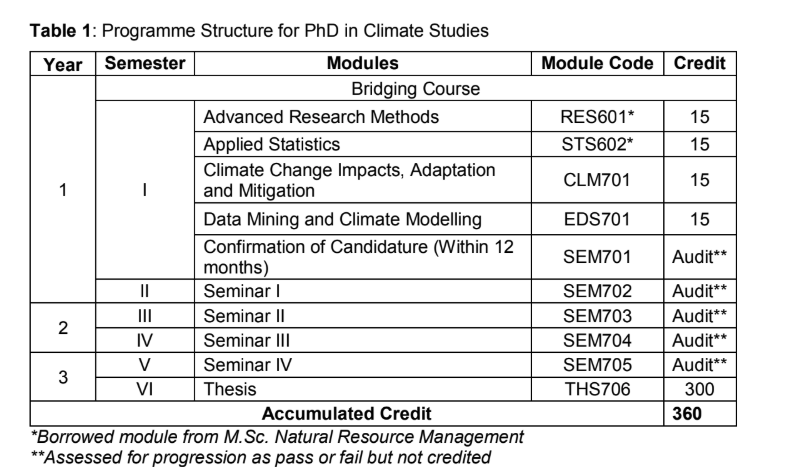
The PhD in Climate Studies is a research-intensive doctoral programme spanning three years full-time or six years part-time, delivered across six semesters, and comprising a total of 360 credits (Table below). The programme is structured in two sequential components: course work (60 credits) and a research component (300 credits). The programme does not include a formal place-based learning; however, work-based learning is embedded within the research phase through fieldwork, data collection, and community and stakeholder engagement conducted in real-world settings relevant to the candidate’s approved research topic.
- Taught Component (Year 1 Semester I)
Prior to the commencement of formal coursework, all candidates are required to complete three compulsory bridge courses in Geographic Information Systems (GIS), Scientific Writing and Communication, and AI Tools in Academia. These are non-credit courses designed to equip PhD student(s) with the foundational technical and communication skills necessary for doctoral
research in climate studies. Following the bridge courses, candidates undertake four compulsory coursework modules: Advanced Research Methods (RES601), Applied Statistics (STS602), Climate Change Impacts, Adaptation and Mitigation (CLM701), and Data Mining and Climate Modelling (EDS701), totalling 60 credits. RES601 and STS602 are borrowed from the MSc in Natural Resource Management and provide the research design and quantitative foundations that directly support CLM701 and EDS701, which develop advanced theoretical and applied competencies in climate science and modelling. Together, these four modules establish the disciplinary, methodological, and analytical foundation required for independent doctoral research. Alongside the coursework modules, candidates develop their doctoral research proposal following the format of Annexure 3.2 under the guidance of supervisory team, culminating in the Confirmation of Candidature (SEM701)
within 12 months. - Research Component (Year 1 Semester II – Year 3 Semester II) Upon successful Confirmation of Candidature, candidates transition to the research phase of the programme and undertake independent doctoral research under the supervision of a Principal Supervisor and at least one Co-supervisor. Research progress is formally evaluated every semester through four compulsory progress seminars (SEM702 to SEM705), each assessed on an audit basis of pass or fail. Each seminar builds directly on the previous one, with SEM702 assessing the foundational research framework (Annexure 9.13), SEM703 evaluating data collection and preliminary findings (Annexure 9.14), SEM704 assessing analytical depth and publication progress (Annexure 9.15), and SEM705 confirming readiness for thesis submission and oral defence (Annexure 9.16). Satisfactory performance in each seminar is a formal prerequisite for registration in the subsequent semester. The doctoral thesis (THS706), carrying 300 credits, is the principal output of the research phase. The candidate may their doctoral thesis either as a monograph or in the thesis by publication format (Annexure 9.19). Prior to submitting the thesis for examination, candidates must fulfil all publication and conference requirements. The final programme grade comprises 20% from the taught component and 80% for the research component. Within the research component, written thesis contributes 75% (Annexure 9.3), while oral defence accounts for remaining 25% (Annexure 9.4).
- Part-Time Mode of Study Part-time candidates follow the same programme structure and are required to fulfil all academic and research requirement applicable to full-time candidates. The taught component and Confirmation of Candidature are completed over two semesters (Year 1 Semester I and Year 1 Semester II), and the research phase extends from Year 2 Semester I through Year 6 Semester II. Candidates are required to present progress seminar every semester throughout the duration of the programme. Part-time candidates must maintain regular contact with their supervisory team and are subject to the same milestones, progression requirements, assessment criteria and quality standards as full-time candidates. Admission to the programme in part-time mode is subject to approval by the Programme Committee and must be supported by a realistic research plan demonstrating that proposed research can be completed within the maximum period of candidature.
- Intermediate Awards There is no intermediate award associated with this programme. However, a candidate who exits the programme before completion may, subject to the recommendation of the Thesis Examination Committee and the approval of the College Research Committee, be considered for the award of a Postgraduate Diploma or a Master’s by Research, in accordance with RDF 2026, Clause 4.8.